The Bank of England’s decision to cut rates to 3.75% has done little to dispel the gloom hanging over the UK’s international economic standing. A chorus of independent forecasters, led by the heavyweight International Monetary Fund (IMF), has issued a stark warning: the UK is on track to suffer the highest inflation rates of any G7 nation for this year and the next. This projection casts a long shadow over the government’s claims of economic stabilization.
This “G7 outlier” status suggests that Britain’s economic problems are structural and deep-rooted, going beyond temporary shocks like energy prices. While the US and Eurozone economies are seeing faster falls in inflation, the UK is struggling with unique pressures, including a tight labor market and Brexit-related trade friction. The Bank’s rate cut attempts to address domestic growth, but it cannot easily fix these international disparities.
The implications of this forecast are severe for British competitiveness. If inflation remains higher in the UK than in Germany or France, British goods and services become relatively more expensive, hurting exports. Furthermore, it erodes the real wages of British workers compared to their international peers. While a rate cut helps borrowing costs, it doesn’t solve the problem of money losing its value faster in London than in New York.
The Bank of England is aware of this disconnect. The split vote reflects the difficulty of setting policy for an economy that is behaving differently from its neighbors. The “doves” prioritize avoiding a recession, while the “hawks” are terrified that the UK’s unique inflation problem requires a uniquely harsh solution—meaning higher rates for longer.
As 2026 approaches, the government will be desperate to prove the IMF wrong. However, the data so far supports the pessimistic view. The UK is walking a lonely path, and while the rate cut offers some comfort, it does not change the fact that Britain is currently the sick man of the G7 when it comes to price stability.
Independent Forecasters Predict UK Will Suffer “Highest Inflation in G7” Through 2026 Despite Bank’s Latest Intervention
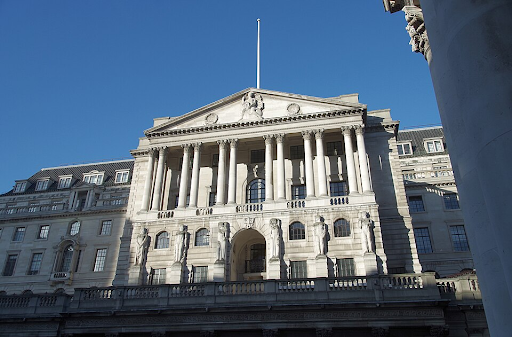
Photo by mattbuck, via wikimedia commons
34